

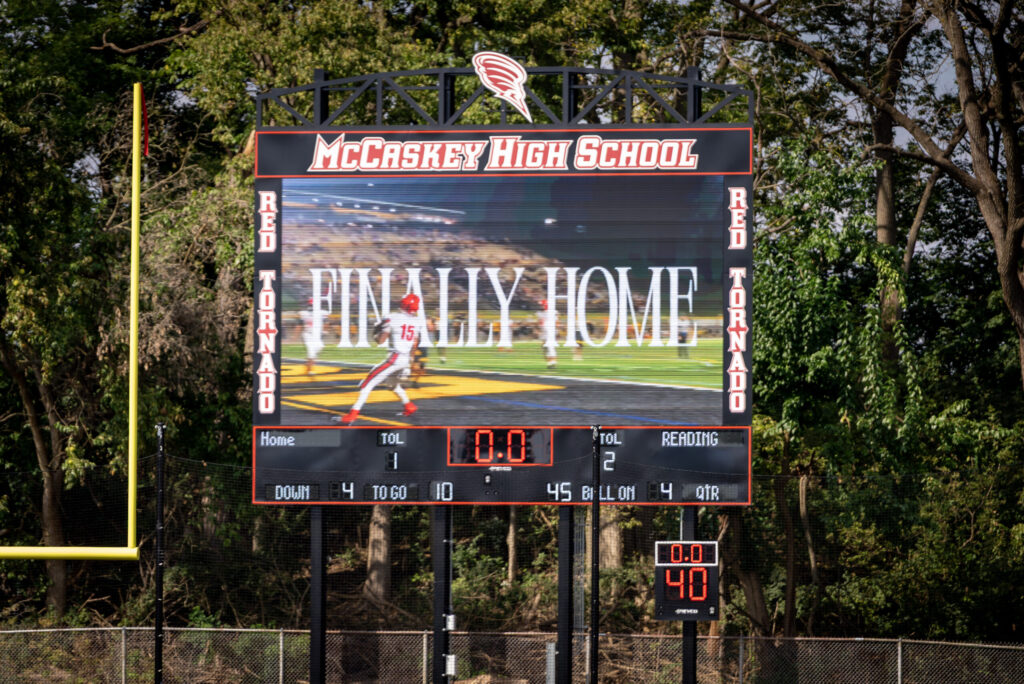
 McCaskey High School cut the ribbon on its newly renovated stadium during a student pep rally on Oct. 2. As the project nears completion, some community members have asked why the district invested in such extensive renovations. This week, we’re taking a Closer Look at the conditions that led to the project, the improvements that were made, and how the final cost compares to similar projects across Pennsylvania.
What is now known as Penn Medicine Lancaster General Health Stadium was originally constructed in 1939 alongside J.P. McCaskey High School. According to McCaskey historian Tom Goodhart, Class of 1980, the home grandstands were added in 1950, the all-weather track was installed in 1988, and stadium lighting was added in 1999.
More than 80 years after its construction, many of the stadium’s core features were approaching the end of their useful life.
In 2021, the district conducted a comprehensive assessment of its athletic facilities in partnership with ELA Sport, Marotta/Main Architects, and Hummer Turfgrass. The study identified significant challenges across the district’s athletic facilities, including the age and condition of the stadium, the heavy use of existing fields, and ongoing difficulties associated with maintaining natural grass playing surfaces.
“It is our experience that the significant majority of K-12 schools do not have the budget or the staff to keep up the necessary maintenance on natural grass fields,” the report stated. The consultants also noted that many neighboring school districts had already transitioned to synthetic turf fields, putting SDoL student-athletes at a disadvantage when practicing on grass but competing on synthetic surfaces.
At the same time, the stadium itself required substantial upgrades. The grandstands and restrooms did not meet modern accessibility standards, the track surface was in poor condition, the field dimensions were undersized for regulation competition, and several safety concerns had been identified around the track and spectator areas.
That’s why the study recommended a comprehensive renovation of the stadium complex, including a synthetic turf field and improvements designed to modernize the facility and better serve students, families, and the broader community.
One question often raised about the project concerns the use of synthetic turf, which carries a higher upfront cost than natural grass. The 2021 study estimated the cost of a new synthetic turf field at approximately $1.2 million, compared with $675,000 for reconstruction of a natural grass field. However, the study also noted that ongoing maintenance, repair, and periodic resodding reduce that difference over time. By year nine, the report estimated the total cost difference between the two options would be less than 20%.
The study also identified a significant difference in field availability. Natural grass fields are limited in how often they can be used while maintaining safe playing conditions. Synthetic turf fields can accommodate substantially more practices, games, competitions, and community events throughout the year. District leaders cite increased access and scheduling flexibility as major benefits of the upgrade.
Those benefits are already being realized. In addition to athletic competitions, the renovated facility is scheduled to host community events, including the TALE-gating reading celebration and a regional marching band competition.
In all, the stadium has undergone its first-ever extensive renovations, including upgraded grandstands and restrooms, new lighting, two press boxes, a video board, improvements to the weight room, and a new synthetic turf field within the stadium itself. The project follows the earlier completion of Fellenbaum Field presented by Citadel Credit Union, a separate synthetic turf facility for soccer and field hockey that opened in 2025 elsewhere within the Barney Ewell Athletic Complex.
The final project cost is approximately $17.7 million, about 5.8% above the original budget. Much of the increase was attributed to delays in the project’s stormwater approval process, which pushed major construction activities into the winter months and increased construction costs. Additional unforeseen infrastructure work, including improvements to a sewer line beneath the field and rock removal, also contributed to the increase.
While every project is different, McCaskey’s renovation is generally consistent with stadium improvement projects being undertaken by school districts across Pennsylvania. Among the most notable examples is Manheim Township School District, which has utilized synthetic turf since 2011 and is now planning additional athletic facility improvements estimated at up to $22.5 million. Norwin School District has announced a stadium modernization project estimated at approximately $33 million, while Cheltenham School District is wrapping up construction on a stadium renovation project estimated at $13 million.
The district recognizes that athletic facilities are about more than sports. They are spaces where students compete, perform, celebrate accomplishments, and build school pride. They also serve as gathering places for families and community members throughout the year.
The district’s 2021 facilities assessment found that several components of the stadium no longer met current standards for accessibility, safety, functionality, and athletic competition. The renovation project was designed to address those deficiencies while creating a facility capable of serving students and the broader community for decades to come.
As with all major capital investments, district leaders and the school board remain committed to helping the community understand how decisions are made and how taxpayer resources are being used to support students. We remain committed to making our schools welcoming community hubs while ensuring our facilities continue to meet the needs of current and future generations of McCaskey students.